Patient Forms
Sedation Dentistry
SANFORD, FL · NEAR ORLANDO
YOU DON'T HAVE TO BE AWAKE FOR THIS.
Sedation Dentistry in Sanford, FL - Sleep Through Your Treatment
Dr. George Mitrogogos performs IV, oral, and nitrous sedation in his own private dental office. The treatment you've been putting off - implants, crowns, root canals, fillings - can happen while you sleep. Often all of it, in one morning.
At Sanford Dental Excellence, not only can you have a comfortable, relaxing dental experience with sedation dentistry but you can also get multiple procedures done in a single appointment.
Book a Free Consultation
WHY PATIENTS DRIVE HERE
6x Best of Sanford Winner
4.9 stars across over 1,000 Google reviews
100 hours of UAB IV sedation certification
1 doctor, start to finish - no associates

MEDICALLY REVIEWED BY
Dr. George Mitrogogos, DMD, AGD Fellow · IV sedation credentialed by the Florida Board of Dentistry
Sedation Dentistry for People Who Have Been Avoiding the Dentist
Most people who call this office about sedation haven't seen a dentist in years. Not because they stopped caring - because a visit went badly once, or the sound alone is enough, or one appointment turned into six and at some point they just stopped going.
Then a tooth breaks. And now there's a list.
Sedation dentistry exists for exactly this.
The list doesn't have to be worked through one nervous appointment at a time - it can be handled while you're asleep, and for a lot of people in a single morning. Dr. Mitrogogos treats patients in Sanford who haven't sat in a dental chair in ten, fifteen, twenty years. It is the most ordinary thing that happens here.
Andrea H. - Google Review“I started to let my dental care go after 2020 and my fear of dental visits took over. The more I avoided going the more I feared the treatment that was needed. When I finally went the staff arranged all my care… My teeth have improved and now I keep my appointments!”
NITROUS OXIDE, ORAL SEDATION & IV SEDATION
What is Sedation Dentistry?
Sedation dentistry is the use of medication to keep a patient calm, comfortable and largely unaware of time passing during dental treatment. It ranges from mild - a gas that takes the edge off - to deep enough that a three-hour appointment feels like a nap. A
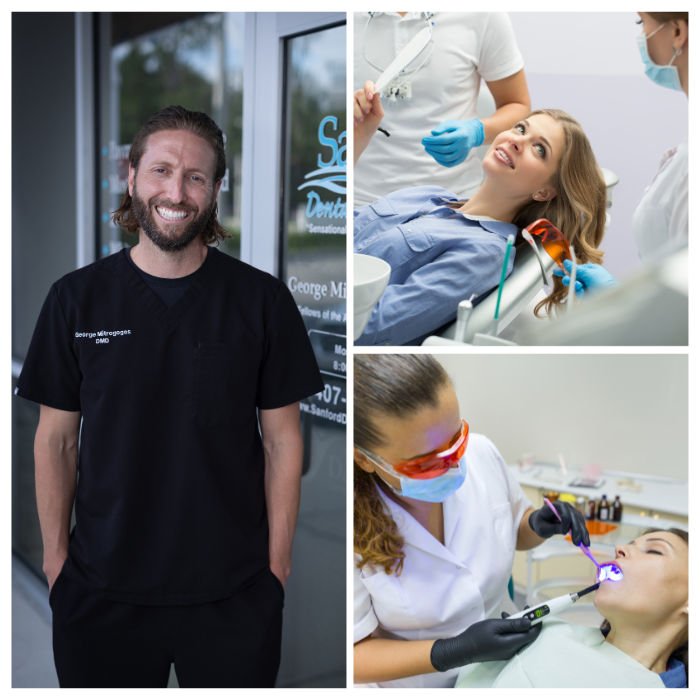
At Sanford Dental Excellence, all three levels are administered in-office by Dr. George Mitrogogos, who is certified in IV sedation through the University of Alabama at Birmingham and credentialed by the Florida Board of Dentistry.
The short version
✔ Three levels are available - nitrous oxide, oral sedation, and IV sedation - chosen to fit the person, not the procedure.
 Several procedures can be combined into one appointment - implants, crowns, root canals, fillings — up to about three and a half hours.
Your first IV sedation appointment is complimentary - for new patients who move forward with cosmetic treatment - a $750 value.
IV sedation is not general anesthesia - fYou breathe on your own the whole time. Heart rhythm, oxygen and heart rate are monitored continuously.
Dr. Mitrogogos administers it himself, in this office. No referral to an oral surgeon, no outside anesthetist, no second appointment somewhere else.
You'll need a driver - and they need to stay with you afterward.

multiple treatments. one visit.
How Many Dental Procedures Can Be Done in One Sedation Visit?
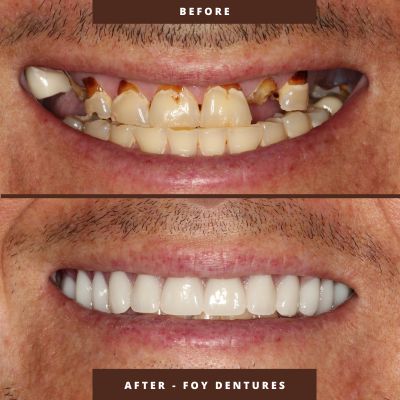
Several dental treatments can be done in a single visit under sedation. Under IV sedation, Dr. Mitrogogos combines treatments such as implants, root canals, crowns, dentures, and fillings into a single appointment - treatment that would normally be split across four or five separate visits.
One recent patient had six procedures completed in about three hours. The practical limit is three and a half to four hours.
For many patients, this, rather than anxiety, is the real reason to choose sedation.
A patient in her sixties came in carrying a treatment plan she’d been putting off. In one appointment:
- Root canal + crownon one tooth
- Two dental implantsplaced
- Two fillingscompleted
- Procedures
- 6
- Appointment
- 1
- Hours
- 3
She slept through all of it.
Broken into conventional appointments, that's four to six visits. Four to six drives to Sanford. Four to six mornings arranged around it - and four to six occasions to lie awake the night before. With sedation, it becomes one appointment.
Is there a limit?
Yes. Treatment under sedation is capped at about three and a half to four hours - not by stamina or scheduling, but by how much medication that much chair time requires and how long the body needs to clear it. Dr. Mitrogogos states the limit plainly:
"We normally don't like going more than about three and a half to four hours. That's about the max - because you start pushing a lot of medication there, and you want their body to be able to clear it out."
Some treatment plans take more than one appointment, and there are two separate reasons for that. The first is time: once treatment runs past about four hours, it gets split into two visits. The second is healing - an implant needs several months to fuse with the bone before the final crown goes on top of it, and that gap is biological. It isn't something sedation shortens.
Either way, you'll know how many visits your treatment takes before you start. It's written into the plan you leave your consultation with, along with the fees.
Why doing it in-house changes the arithmetic
Most general dentists who place implants don't administer IV sedation themselves. That leaves two options:
ELSEWHERE
An outside nurse anesthetist is brought in, or you're sent somewhere else to be sedated and back again for the restorative work. Two schedules, two fees, two sets of hands.
HERE
The consultation, the sedation, the surgery and the restorative work are done by the same dentist, in the same building, on the same day.
"A lot of them don't do IV sedation. So then they'll have to bring either a nurse anesthetist in, or send you somewhere else to get sedated - and then the cost on that is significant. Keeping it in-house, being able to do the sedation, being able to place the implants, and also knowing how to do the prosthetics - everybody likes keeping it under one roof."
DR. GEORGE MITROGOGOS
Find out what can be done in one visit.
A complete exam, X-rays, photos and a written treatment plan - no charge, no obligation to schedule anything.
Book a Free Consultation
What are the Different Types of Dental Sedation?
There are three levels of dental sedation: nitrous oxide (laughing gas), oral sedation, and IV sedation. They differ in how deeply relaxed you become, how much of the appointment you remember, and how long the effect takes to clear. All three are administered in-office at Sanford Dental Excellence by Dr. George Mitrogogos.
Dr. Mitrogogos doesn't treat these as a menu with a default. It is always customized for each patient and their individual needs.
-
Nitrous oxide
Laughing gas · Lightest
Takes the edge off and raises your tolerance for discomfort. You stay fully aware and you’ll remember it.
Clears in minutes. The only one of the three you can have and still drive yourself home.
-
Oral sedation
Pills · Middle
Deeply relaxed, often very sleepy. The medication blocks the memory of the appointment from forming at all.
Driver required. Often combined with nitrous, which deepens the effect considerably.
-
IV sedation
Deepest level · In-house
Asleep, in every way that matters to you. Delivered through a line and adjusted continuously throughout the appointment.
Makes the one-visit model possible. Four to six hours of grogginess afterward.
“It really depends on the person. We have to customize a sedation experience for each person.”
| What to compare | Nitrous oxide | Oral sedation | IV sedation |
|---|---|---|---|
| How it’s given | Gas, through a small nosepiece | One or two pills at the office | Through an IV line, adjusted continuously |
| How you feel | Comfortable, a little buzzed, more tolerant of discomfort | Deeply relaxed, often very sleepy | Asleep, in every way that matters to you |
| Will you remember it? | Yes | Very little — the medication blocks the memory forming | No |
| Wears off | Within minutes | Several hours | Four to six hours of grogginess |
| Driver required? | No | Yes | Yes |
| Best for | Mild nerves, shorter visits | Moderate anxiety; when IV isn’t wanted or affordable | Real anxiety, long visits, or several procedures at once |
What is Nitrous Oxide Sedation? (laughing gas)
The lightest option and the fastest to clear. It raises your tolerance for discomfort and makes the appointment feel shorter, but you stay fully aware and you'll remember it.
"The gas is the least. It kind of gets you a little high, gets you buzzed, you're comfortable. It increases your pain tolerance, so a lot of people love that. But it's for people that aren't really that anxious or that nervous. It just takes the edge off a little bit." - Dr. Mitrogogos
It's also the only one of the three you can have and still drive yourself home.
Learn More About Nitrous Oxide (laughing gas) Sedation
What is Oral Sedation?
One or two prescription pills taken at the office. You stay awake and responsive — but the medication causes retrograde amnesia, so the memory of the appointment never forms.
"You're still there, you still experience it, you're very calm, sometimes very, very sleepy — but you don't remember any of it. So you end up at home, you're like, 'What just happened?'" - Dr. Mitrogogos
Oral sedation is often combined with nitrous, which deepens the effect considerably. For patients who want a substantially calmer visit without the cost of IV, that combination works better than most people expect.
Learn More About Oral Sedation
What is the Difference Between IV Sedation and Oral Sedation in Dentistry?
Delivery and control. Oral sedation is a fixed dose - you take the pills and the effect is whatever that dose produces. IV sedation runs through a line and is adjusted continuously during the appointment, so the depth can be increased or lightened at any moment in response to how you're doing.
That control is what makes IV the option for long, combined visits. For a single filling or moderate nerves, oral sedation is genuinely a good answer. For three hours and six procedures, it isn't.
What is IV Sedation Dentistry?
The deepest level of dental sedation offered at Sanford Dental Excellence, and the one patients travel for.
Medication goes in through a small line and is adjusted throughout the appointment. Most patients have no memory of it at all. Everything below on this page - safety, who's a candidate, what it costs, how to prepare - applies to IV sedation.
If you'd like the appointment itself walked through step by step, from arriving in the morning through the IV going in, the monitoring, waking up, and the drive home, that's on the IV sedation dentistry page.
Learn More About IV Sedation
"The IV is kind of the best one, where you feel like you're almost completely out."
DR. GEORGE MITROGOGOS
Is IV sedation the same as general anesthesia?
No. IV sedation in a dental office is moderate sedation - sometimes called conscious sedation. You breathe on your own, you keep your reflexes, and you can respond if someone speaks to you. General anesthesia - the hospital version - means a breathing tube and complete unconsciousness. Different procedure. Not what happens here.
MODERATE SEDATION - WHAT HAPPENS HERE
✔ You breathe on your own
✔ Your reflexes stay - you can still cough
✔ No breathing tube
✔ EKG, pulse oximetry and heart rate monitored throughout
GENERAL ANESTHESIA - THE HOSPITAL VERSION
― Breathing is managed for you
― Reflexes fully suppressed
― Breathing tube placed
― Complete unconsciousness
"You're still breathing on your own. We're monitoring your vitals - EKG, pulse ox, heart rate. But you can still cough if you have a cough. You can still feel pain if you're not numb. So there's a lot we can monitor and control to keep it safe - but you also wake up and you're done, and you can do long procedures, difficult procedures, and it makes you feel like you were barely even there."
DR. GEORGE MITROGOGOS
What does it actually feel like?
For most people, like nothing - which is the entire point. You get comfortable, and the next thing you're aware of is being finished. Patients routinely open their eyes and ask whether anything has happened yet.
"The one thing I hear from everybody - it's the best sleep they've ever gotten."
DR. GEORGE MITROGOGOS
Afterward you'll be groggy for four to six hours. Plan on the rest of the day at home.
One more thing worth saying, because sedation and numbing get confused:
"We get you numb. If you're worried or anxious or whichever, we get you sedation. If you're sedated, you still have to get numb."
DR. GEORGE MITROGOGOS
They do two different jobs. You get both.
Brooke · Google review“I was scared to death because I knew even with the sedation I’d have to get numbing needles. Dr. Mitrogogos is so gentle and so caring about his patients I didn’t even feel the needle. The whole thing was over in a matter of 5 minutes - I drew it out longer being scared and crying when in reality I had nothing to be scared of.”
Do you have to be afraid of the dentist to choose sedation?
No. You don't have to be afraid of the dentist to choose sedation, and a real share of the patients who choose it at Sanford Dental Excellence aren't anxious at all. They choose it because three hours in a dental chair is uncomfortable for reasons that have nothing to do with fear.
- Back trouble
- A neck that won't tip back
- Difficulty staying still
- A strong gag reflex
- Not wanting to listen to it
"Some people that aren't anxious, but they know the procedure's going to be long and they have back problems or a stiff neck or something along those lines - they still opt to do sedation, just to be comfortable for those two and a half, three hours." - Dr. George Mitrogogos
All ordinary reasons. None of them need justifying.
The other end of the range is worth knowing too. Asked whether he'd sedate someone just for a cleaning, Dr. Mitrogogos didn't hedge - "I'd have to be the one doing the cleaning - but yes, I can do it for a cleaning."
If fear has kept you out of a dentist's chair entirely, there is a version of this that works for you.
THE CREDENTIAL CHAIN
Is IV sedation in a dental office safe?
Yes - when it is performed by a dentist credentialed to do it. In-office IV sedation is not something a dentist can simply decide to offer. It requires university-level certification, a live credentialing case performed in front of the Florida Board of Dentistry, and annual retraining. Dr. Mitrogogos holds all three and has been sedating patients in this office for years.
100
Hours of university certification
Through the University of Alabama at Birmingham.
1
Live case before the state board
A supervised sedation case performed and passed in front of the Florida Board of Dentistry.
Every year
Emergency drills, on site
A team comes to the office with mannequins and scenarios, and the whole practice runs the protocols.
So why don't more dentists offer it?
Because the training is expensive, implementing it is demanding, and a certification you never use is money spent for nothing. He's sympathetic rather than dismissive about it:
"You have to be able to come back and implement it, because it's a waste of time and money if you can't. And there's a lot of people that are scared to offer that — and I don't blame them." - Dr. George Mitrogogos
The gap that leaves is one he sees from the patient side every week:
"I get a lot of sedation patients that want to come in, and they're telling me they can't find doctors that do IV sedation. There are a lot of oral surgeons that do IV sedation for wisdom teeth and extractions, maybe some implants. But there aren't that many yet who will say, 'You need to be put to sleep for fillings - come on in, let me do it for you.'" - Dr. George Mitrogogos
Who is not a candidate for in-office IV sedation?
Patients with a high BMI, significant cardiovascular history, severe COPD or asthma, or liver or kidney disease may not be candidates for in-office IV sedation. Candidacy is determined at an in-person medical review before anything is scheduled — not on the morning of the appointment.
A high BMI
It affects the airway and how the medication is processed.
Significant cardiovascular history
Reviewed in full before anything is scheduled.
Severe COPD or asthma
Breathing conditions change what's appropriate in an office setting.
Liver or kidney disease
Both affect how the body clears the medication.
"When your medical status is compromised - when you've had multiple heart attacks, you've had liver or kidney disease, you have COPD or asthma - those are a lot of things we have to go over with the patient multiple times, and based off of that, judge if they're okay with getting sedation in the office or not." - Dr. George Mitrogogos
If IV isn't the safest choice for you, that's not the end of the conversation. Oral sedation combined with nitrous is frequently the right answer instead, and for most patients it works well.
Do my medications affect sedation?
Some do. The most significant right now is the GLP-1 class of weight-loss and diabetes medications, because they slow digestion and keep food in the stomach longer than normal.
"It slows down digestion, keeps things in your stomach a little longer. So what we normally recommend is stopping a week beforehand, before your sedation procedure." - Dr. George Mitrogogos
Depending on the medication and the dose, that window runs one to two weeks. It's reviewed at your consultation, in coordination with your prescribing physician — never adjusted on your own. A full medication and medical history review is part of every sedation evaluation.
Bring the list. All of it, including supplements.
How does sedation dentistry help with dental anxiety?
By removing the part people are actually afraid of. Dental anxiety is rarely about pain in the abstract — it's about being awake, aware, and not in control for an hour. Sedation takes all three off the table: you are calm before the appointment starts, you have no memory of it, and you wake up finished.
If fear is the reason you stopped going, you're describing the most common patient story in this practice. Adults who haven't seen a dentist in ten, fifteen or twenty years are not unusual here. Nobody comments on it. Nobody lectures you about the gap.
For patients whose anxiety makes walking through the door the hard part, there's a step before the sedation itself:
"Sometimes people are so anxious we've got to give them a pill just to walk into the office. So we give them one of those happy pills where they forget. They walk into the office, they're already calm." - Dr. George Mitrogogos
From there the IV goes in, and the appointment happens without you.
Will I say something embarrassing?
Probably. It's a real worry and it's worth answering honestly rather than pretending it doesn't happen. Asked directly whether sedated patients say embarrassing things, Dr. Mitrogogos laughed: "Of course. That's the best part."
Nobody in the room is surprised, nobody is judging and nobody outside that room hears about it. You almost certainly won't remember it either.
The other thing worth saying plainly: dental problems don't hold still. A tooth that a root canal could have saved two years ago may need an extraction and an implant now. That isn't a reason to feel worse about the delay. It's the reason the next step is worth taking sooner than later.
Stacey N. · Google review“Coming from someone who would cry just making an appointment due to a childhood dentist, to getting work done without even needing nitrous! They are kind, caring and definitely worth every penny.”
How do I prepare for a sedation appointment?
Three things: don’t eat for at least 8 hours beforehand, arrange a driver who can stay with you afterward, and bring a complete list of your medications. Sedation appointments at Sanford Dental Excellence are scheduled in the morning because of the fast.
None of it is left to memory — the office confirms all three with you twice, about two weeks out and again two days before.
-
Don’t eat beforehand
Nothing to eat for at least 8 hours before your appointment. Water and clear liquids are fine.
If you take a GLP-1 medication for weight loss or diabetes, the rule is stricter: nothing to eat or drink for at least 12 hours. You’ll also be asked to pause the medication one to two weeks beforehand — reviewed at your consultation, in coordination with your prescribing physician.This one isn’t flexible. If you eat before your appointment, it has to be rescheduled. That’s a safety rule, not an office preference — so tell the team honestly if it happens. It’s a moved morning, not a problem.
-
Arrange a driver
You can’t drive yourself to or from the appointment.
“Somebody has to drive you here, they have to stay here with you, and then they also have to take you home. And when they take you home, they can’t just drop you off — they’ve got to stay with you for a while. Because the type of medications we give, you’re groggy, you’re sedated, and we don’t want you at home stumbling and falling.”
You also won’t reliably remember the first hour or two after you leave.
-
Bring your medication list
Everything, including supplements. If you’re on a GLP-1, mention it early — that one changes the timeline.
Sedation appointments run in the morning, because of the fast. The practice does two to three of them per morning. Sedation appointments here book roughly six to eight weeks out — that wait is about who can perform the procedure, not about demand tactics.
6–8 weeks
Sedation appointment
About 2 weeks
Your first appointment
The first appointment is not the one with the wait. You can have your exam, your X-rays and a written plan with fees in hand well before a sedation date is set.
How much does sedation dentistry cost?
The cost of sedation dentistry depends on the level of sedation and how long the appointment runs, so it is quoted against your actual treatment plan rather than published as a flat fee. At Sanford Dental Excellence, IV sedation is complimentary with any cosmetic dental procedure - a $750 value.
CURRENT OFFER
Free IV sedation
a $750 value
first-time sedation with any cosmetic dental procedure
What else can be said up front:
Oral sedation and nitrous cost less than IV, and for many patients they work very well - especially combined.
Every fee is written down before anything starts. You leave the consultation with an itemized plan, and Tracy goes through payment and financing at the end of that same visit.
CareCredit financing is available. There's also an in-office dental discount plan, which is a membership rather than financing.
Why is the first one free?
Because the alternative is patients talking themselves out of it, having a hard appointment, and concluding that dentistry is something to avoid. Dr. Mitrogogos's own explanation:
"It's a way of us saying: our office does IV sedation. It's safe. Try it. And if you want it again in the future, then it's on you."
"Once you do it once, it helps the procedure go by so fast, and so safely, so calm - everything just works out so well that it's like an experience. You introduce it to them once, they're going to want it again."
GETTING HERE
Where can I find a sedation dentist near Orlando, FL?
Sanford Dental Excellence is in Sanford, Florida, about 25 minutes north of downtown Orlando. Patients drive in from Winter Park, Oviedo, Lake Mary, Longwood and Orlando itself for in-office IV sedation performed by the dentist doing the treatment - which, as the people who call here have usually already found out, is not something most practices in the area offer.
For anyone making that drive, the one-visit model is the point. A plan that would take four or five appointments closer to home becomes one morning in Sanford - which is fewer trips, not more.
<15 mins
Lake Mary & Heathrow
15 mins
Longwood
20-25 mins
Oviedo & Winter Park
25-30 mins
Downtown Orlando
FROM PATIENTS WHO FELT THE SAME WAY
What anxious patients say afterward
Michael S.Avoided care for years“As a phobic patient who avoided necessary dental care for far too long, this practice has brought me back to regular and crucial dental care — including an implant — comfortably. Highly recommend.”
ChrisSevere dental phobia“I have a severe dental phobia and they have accommodated my needs extensively so I could get work done.”
Lauren C.A multi-year treatment plan“With each visit and procedures explained in great detail and no question left unanswered, my anxiety and fear was melted away. You cannot put a price on feeling comfortable as a patient. They changed my life and gave me my smile back.”
4.9 stars across over 1,000 Google reviews · Read all reviews
Sedation dentistry - frequently asked questions
Is IV sedation the same as being put to sleep for surgery?
No. IV sedation in a dental office is moderate sedation - you breathe on your own, keep your reflexes, and can respond if spoken to. General anesthesia in a hospital involves a breathing tube and full unconsciousness. Moderate sedation is a lighter, safer procedure appropriate for dental treatment.
What is the difference between IV sedation and oral sedation?
Delivery and control. Oral sedation is a fixed dose taken as one or two pills, and the effect is whatever that dose produces. IV sedation runs through a line and is adjusted continuously during the appointment, so the depth can be raised or lightened at any point. That control is what makes IV suitable for long appointments combining several procedures.
Can I have several procedures done in one appointment?
Yes. Implants, crowns, root canals, fillings and cosmetic work can be combined into one sedation appointment of up to three and a half to four hours. Some plans still need a second visit for healing, and you’ll be told that at your consultation.
Do I need someone to drive me?
Yes, for IV and oral sedation. Your driver needs to stay at the office during the procedure, take you home, and stay with you afterward. Nitrous is the exception - it clears within minutes and you can drive yourself.
Do my medications affect sedation?
Some do. GLP-1 medications for weight loss and diabetes slow digestion and generally need to be paused one to two weeks beforehand, with a 12-hour fast rather than 8. Exact timing depends on your medication and dose and is reviewed at your consultation, in coordination with your prescribing physician. Bring a complete medication list.
What if I accidentally eat before my appointment?
It has to be rescheduled. That’s a safety requirement, not an office preference - tell the team honestly rather than going ahead.
Will I feel anything?
No. You’re numbed locally in addition to being sedated - the two do different jobs. Between them, patients typically feel nothing and remember nothing.
How long do I have to fast before dental sedation?
At least 8 hours with nothing to eat. Water and clear liquids are fine. If you take a GLP-1 medication for weight loss or diabetes, it’s stricter - nothing to eat or drink for at least 12 hours and you may have to stop your GLP-1 medication prior to your appointment. All sedation appointments at Sanford Dental Excellence are scheduled in the morning because of the fast. For specific medication and sedation concerns, give our office a call.
Who is not a candidate for in-office IV sedation?
Patients with a high BMI, significant cardiovascular history, severe COPD or asthma, or liver or kidney disease may not be candidates. Oral sedation combined with nitrous is often an effective alternative. Candidacy is determined at an in-person evaluation.
Is the first IV sedation really free?
IV sedation is complimentary with any cosmetic dental procedure at Sanford Dental Excellence - a $750 value. Dr. Mitrogogos’s reasoning is that patients who try it once almost always choose it again, so the practice would rather remove the barrier on the first one than have someone talk themselves out of a calmer appointment.
How far in advance do I need to book?
Sedation appointments book roughly six to eight weeks out, and all of them are scheduled in the morning because of the fasting requirement. The first appointment is different: new patient exams at Sanford Dental Excellence book about two weeks out, Monday through Thursday.
Schedule Your Complimentary Cosmetic Dentistry Consultation
A two-hour new patient exam: complete exam, full X-ray series, intraoral photos, and a written treatment plan with your actual fees. Yours to keep whether or not you treat here.
Call Now